
📉 Indian IT Selloff Explained: Profit Booking, AI Fear or Structural Change?
Introduction — When Prices Fall but Businesses Don’t
Over the past few months, Indian IT stocks have entered a decisive phase of weakness.
Mid-cap leaders like Coforge, Persistent Systems, Oracle Financial Services Software (OFSS), and Mphasis have slipped toward key technical supports. Large-cap giants such as Infosys, TCS, HCLTech and Wipro have also lost momentum.
At first glance, the selloff appears alarming.
But a deeper look reveals something fascinating:
👉 Underlying business fundamentals remain largely stable.
Revenues continue to rise.
Profitability largely remains intact.
Deal pipelines haven’t collapsed.
So why are investors selling?
Because markets don’t price the present.
Markets price the future.
And right now, the future of IT services is being questioned globally.
📊 Mid-Cap IT: Strong Growth, Weak Price Action
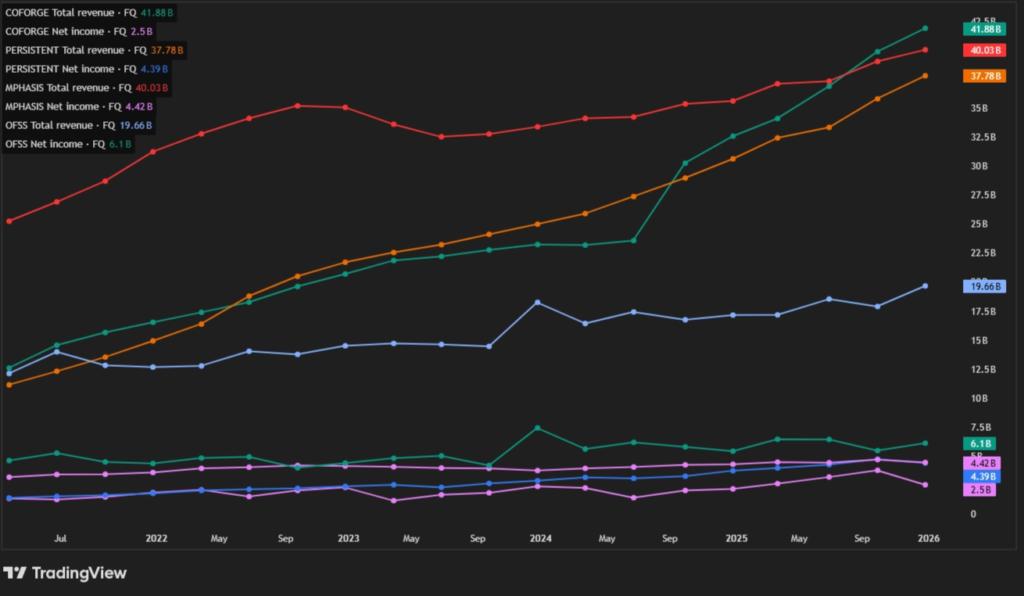
Mid-cap IT companies continue showing strong revenue expansion despite sector-wide price corrections.
Mid-cap IT companies were among the biggest wealth creators in the Indian market between 2022 and 2024.
Companies like Coforge and Persistent Systems delivered:
- consistent deal wins,
- strong revenue compounding,
- improving margins,
- and premium growth narratives.
Yet stocks corrected sharply.
This tells us one important thing:
👉 The market isn’t reacting to earnings weakness — it is reacting to changing expectations.
Mid-cap IT stocks had reached valuations assuming years of uninterrupted high growth. Once uncertainty entered the narrative, valuations adjusted quickly.
📊 Large-Cap IT: Stability Without Excitement
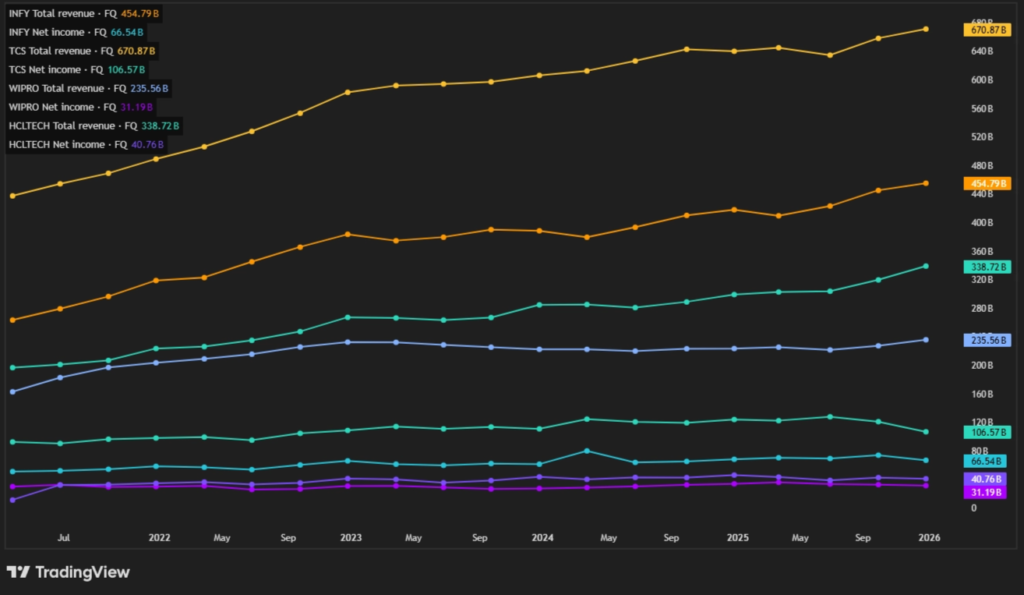
Large-cap IT companies maintain steady growth, but lack of acceleration is weighing on market sentiment.
Large-cap IT companies tell a slightly different story.
- TCS continues delivering consistent revenue expansion.
- Infosys shows steady but moderated growth.
- HCLTech maintains execution strength.
- Wipro remains relatively slower compared to peers.
The problem here is not decline — it is absence of acceleration.
Markets reward growth acceleration far more than stability.
When growth becomes predictable rather than explosive, valuations compress even if earnings remain strong.
This is exactly what the sector is experiencing today.
🌍 The Global Link — Why Indian IT Moves With Wall Street
Indian IT is fundamentally a global business.
More than two-thirds of revenues come from overseas clients, particularly:
- United States enterprises
- European corporations
- Global financial institutions
This means Indian IT stocks behave less like domestic companies and more like global technology proxies.
Currently, global enterprises are entering a cautious spending phase.
Key trends emerging worldwide:
- CIOs delaying discretionary digital transformation projects
- Clients renegotiating contracts for cost optimization
- Slower conversion of large technology deals
- Increased focus on efficiency rather than expansion
After aggressive technology spending during the pandemic years, corporations are now reassessing budgets.
The result?
👉 Growth isn’t disappearing — but visibility is declining.
And markets dislike uncertainty more than slowdown itself.
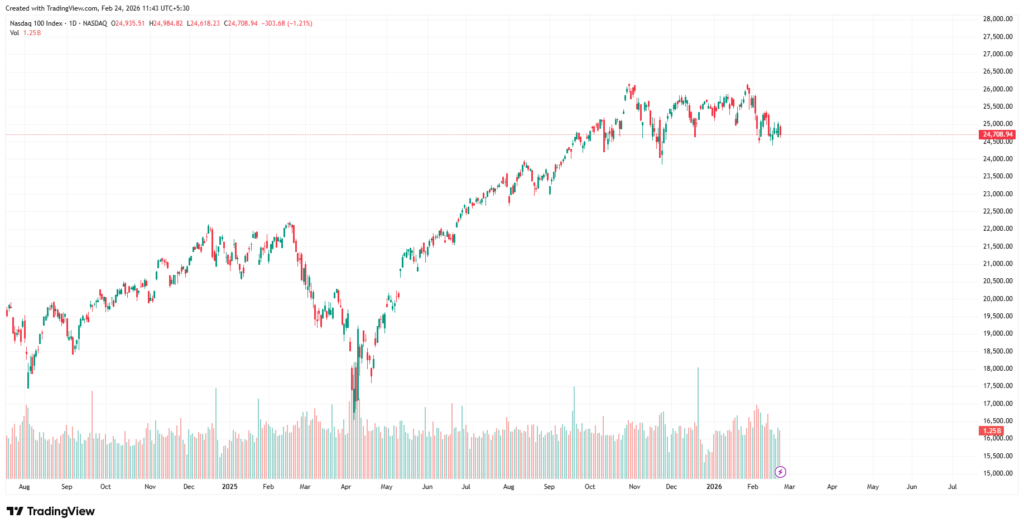
This visually connects Indian IT weakness with global technology sentiment.
🤖 The AI Question — The Real Reason Behind the Selloff
If one factor explains the intensity of the correction, it is artificial intelligence.
Generative AI has introduced a structural debate within global markets:
What happens to outsourcing when software can build itself?
Traditional Indian IT services were built on a powerful model:
- Large engineering workforce
- Billing based on employee hours
- Long-term maintenance contracts
AI changes the economics.
Modern AI tools can now:
- generate code,
- automate testing,
- maintain systems,
- optimize infrastructure,
- and reduce manual intervention.
Investors fear a future where productivity rises faster than billing opportunities.
Even if revenues remain stable today, the market worries that long-term pricing power could weaken.
This fear alone is enough to trigger valuation compression.
Importantly, this does not mean Indian IT will decline.
It means markets are reassessing how these companies will evolve.
💰 Interest Rates — The Invisible Pressure
Technology stocks globally are highly sensitive to interest rates.
Why?
Because IT companies derive value from expected future earnings.
When interest rates remain elevated:
- Future profits are discounted more heavily.
- High-valuation sectors become less attractive.
- Investors shift toward near-term cash flow businesses.
Over the last year, expectations of aggressive global rate cuts have repeatedly been pushed back.
This has directly pressured technology valuations worldwide.
Indian IT stocks are simply reflecting this global macro reality.
🔄 Profit Booking & Market Rotation
Another critical but less dramatic reason is capital rotation.
Markets operate in cycles.
After years of strong performance, IT became an overcrowded trade.
Investors have recently shifted capital toward sectors with stronger domestic visibility:
- Banking & financials
- Capital goods
- Infrastructure
- Manufacturing
- Consumption themes
These sectors benefit from India’s domestic growth story, while IT remains tied to global economic conditions.
This rotation creates selling pressure even without negative company news.
📉 Why Mid-Caps Fell Harder Than Large Caps
Mid-cap IT stocks experienced sharper corrections for three main reasons:
1. Higher Valuations
Many mid-caps traded at significant premiums relative to historical averages.
2. Growth Expectations Were Extremely High
Even small disappointments led to large price reactions.
3. Institutional Positioning
When funds reduce risk exposure, mid-caps are usually sold first due to liquidity considerations.
Thus, the correction appears violent — but structurally logical.
🧠 Market Psychology — Expectations vs Reality
The IT sector today represents a classic market phenomenon:
Prices correcting ahead of fundamentals.
Businesses continue operating normally.
Clients still spend on technology.
Earnings remain intact.
But investors are recalibrating future assumptions.
Markets are asking:
- Will AI reduce manpower dependency?
- Will outsourcing margins compress?
- Will growth normalize after pandemic acceleration?
Until answers become clearer, volatility will remain elevated.
⚖️ Bull vs Bear Case for Indian IT
🐻 Bear Case
- AI reduces billing hours
- Global tech spending stays muted
- Margin pressure increases
- Growth slows structurally
🐂 Bull Case
- AI increases enterprise technology adoption
- Indian IT becomes AI implementation partner
- New consulting opportunities emerge
- Productivity gains expand margins long term
Historically, technological revolutions create new winners rather than eliminate industries.
🔮 What Investors Should Watch Next
Key signals to monitor:
- Large deal wins from US clients
- AI-led service offerings announcements
- Hiring trends in IT companies
- Margin commentary in earnings calls
- Global tech spending outlook
These indicators will decide whether the current correction becomes accumulation opportunity or prolonged consolidation.
Final Thoughts — A Sector in Transition
The Indian IT selloff is not a story of collapse.
It is a story of transition.
The sector stands at an inflection point where:
- stable present performance meets
- uncertain technological future.
The market is not abandoning IT.
It is repricing it.
And historically, periods of maximum uncertainty have often laid the foundation for the next leadership cycle.
The real question now is not whether IT survives?
Which companies will lead the AI era of global technology services?